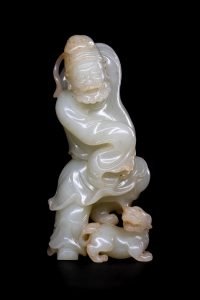
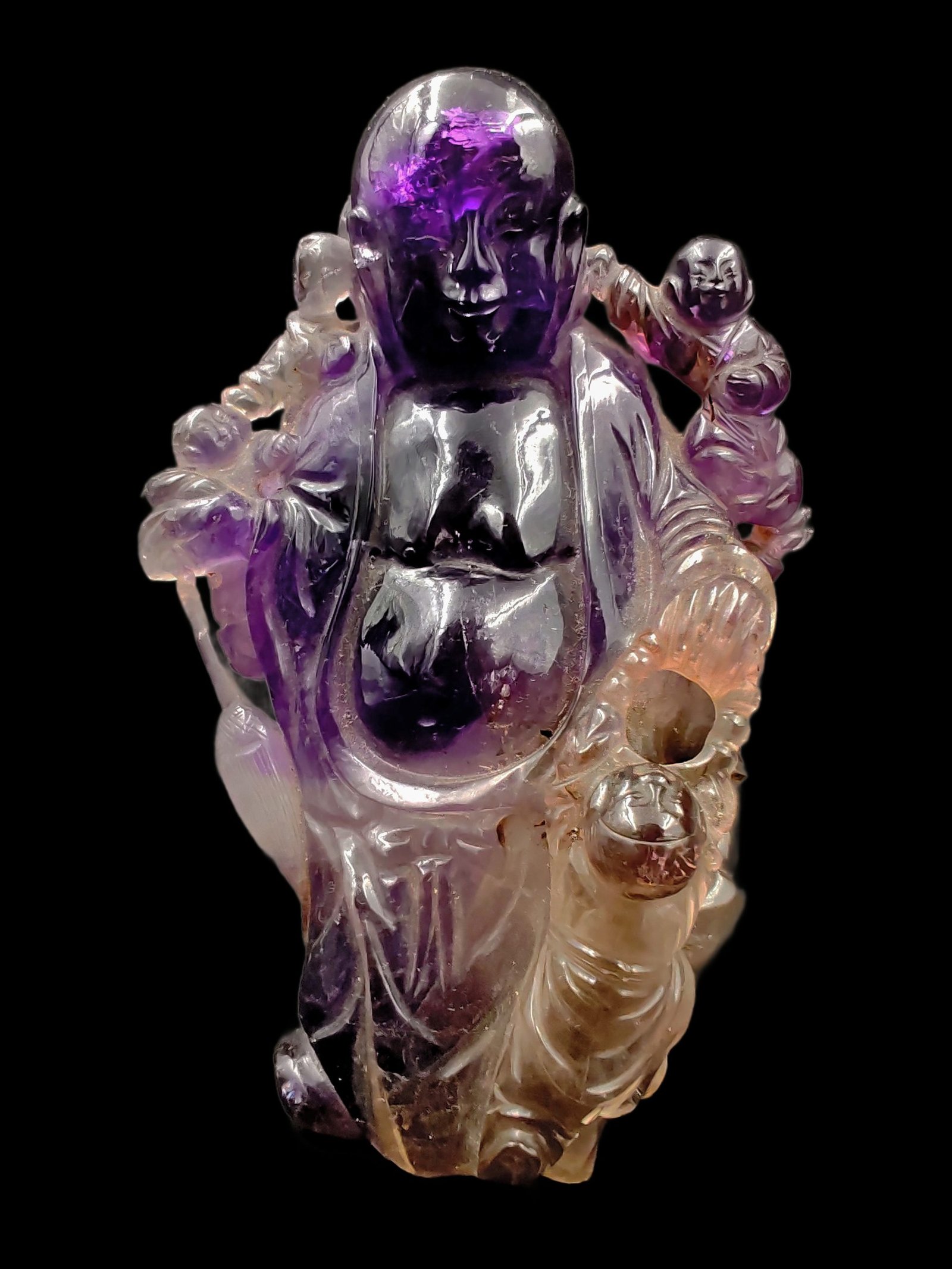
Amethyst carving from 18th century China, depicting the monk Budai. Thanks to the amethyst, both stronger and weaker shades of purple stand out throughout the body of the small statue, especially on the head and abdomen. Budai, also known as Pu-taj or the “Laughing Buddha”, was a prominent monk whose cult developed from Chan Buddhism and reached into Taoism and Shintoism. Budai, who lived sometime around the 10th century, gave his name meaning “canvas bag”, referring to the bag he carried with him at all times. Budai was a monk who had a constant smile on his face, who, according to many stories, loved to eat and drink, who, despite being poor, exuded happiness and contentment, and who often touched his beautiful round belly. After his death, Chinese culture made him a representative of abundance and happiness, making him an important character in Chan Buddhism. In the carving, the happy Budai is not alone, with children hanging from his arms and legs, evoking the stories of how he was constantly followed by children. In his right hand is the famous bag in which, according to tradition, he brought good luck to those who met him.
Budai is one of the most famous monks in the Buddhist religion because of his striking appearance and energy. According to legend, he was always on the move and carried his little bag with him everywhere; he could sleep anywhere, even in the open air, where it could be cold, he was never cold, never tormented. He was also able to predict the future of people and even the weather. In his last record before his death, he refers to himself as Maitreya, the Buddha of the Future. His statue was displayed in many Chan Buddhist pantheons with the aim of promoting the religion, as this positive character could appeal to and attract more people.
Chan Buddhism:
Chan is the Chinese equivalent of Zen Buddhism in Japan. It emphasises the importance of meditation, and mindful presence.