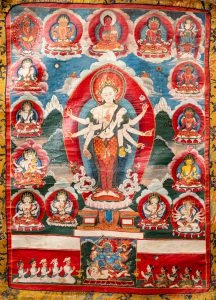
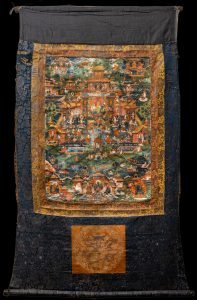
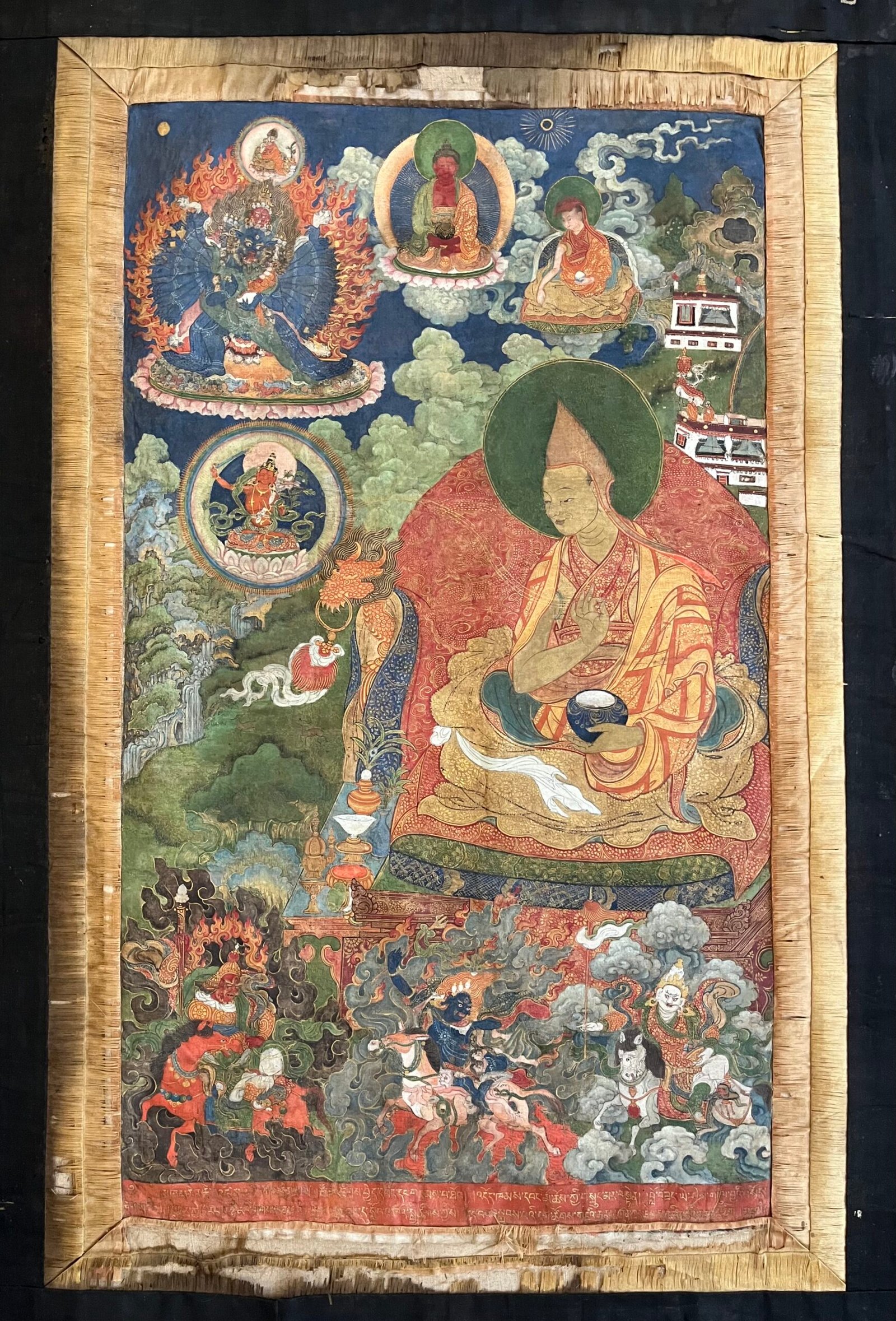
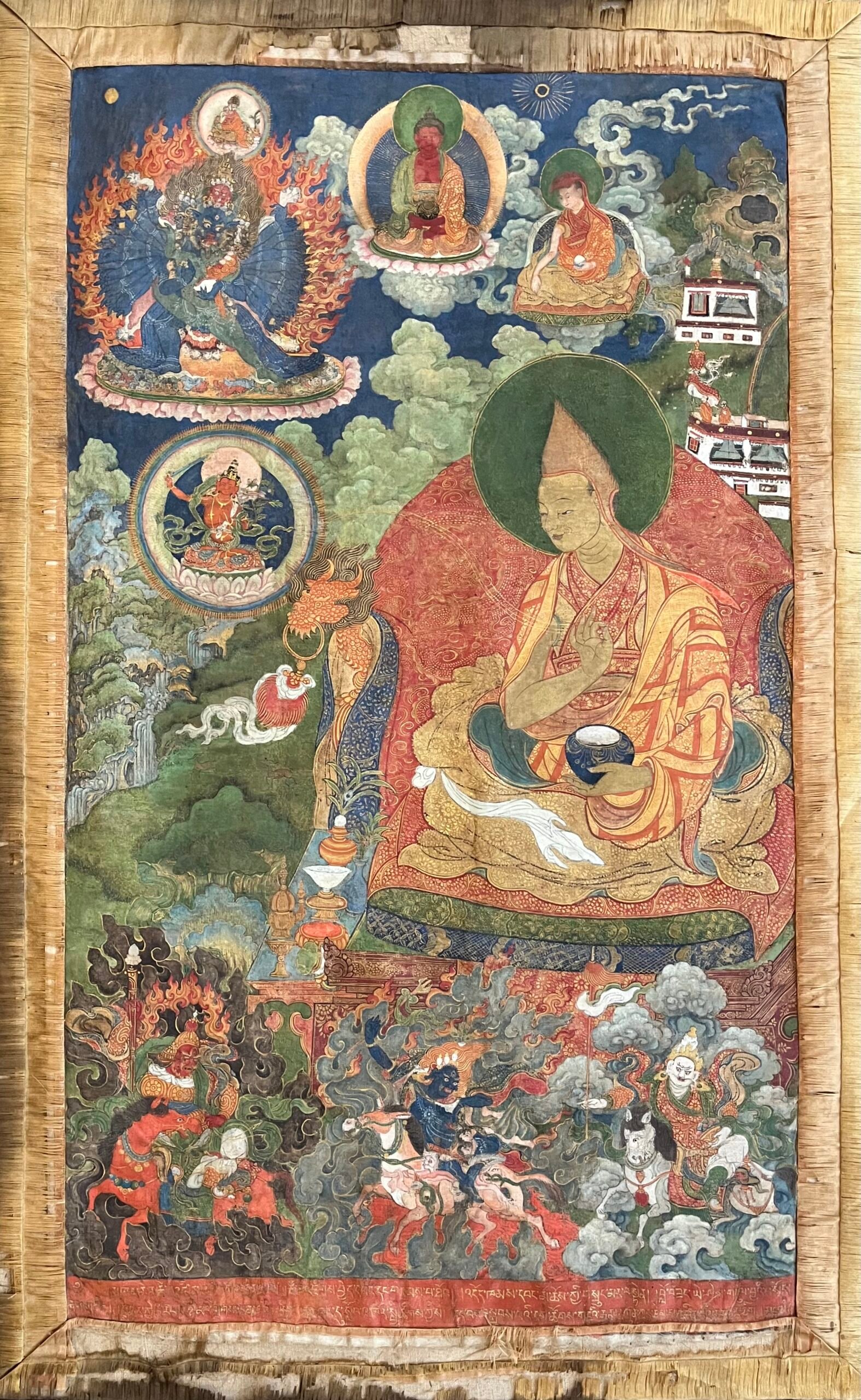
The central figure of this thangka is Lobzang Yeshe (blo bzang ye shes) (1663–1737),
identified according to differing Tibetan historiographical traditions as either the Fifth
Paṇchen Lama (Tashilhunpo system) or the Second Paṇchen Lama (Ganden Podrang system).
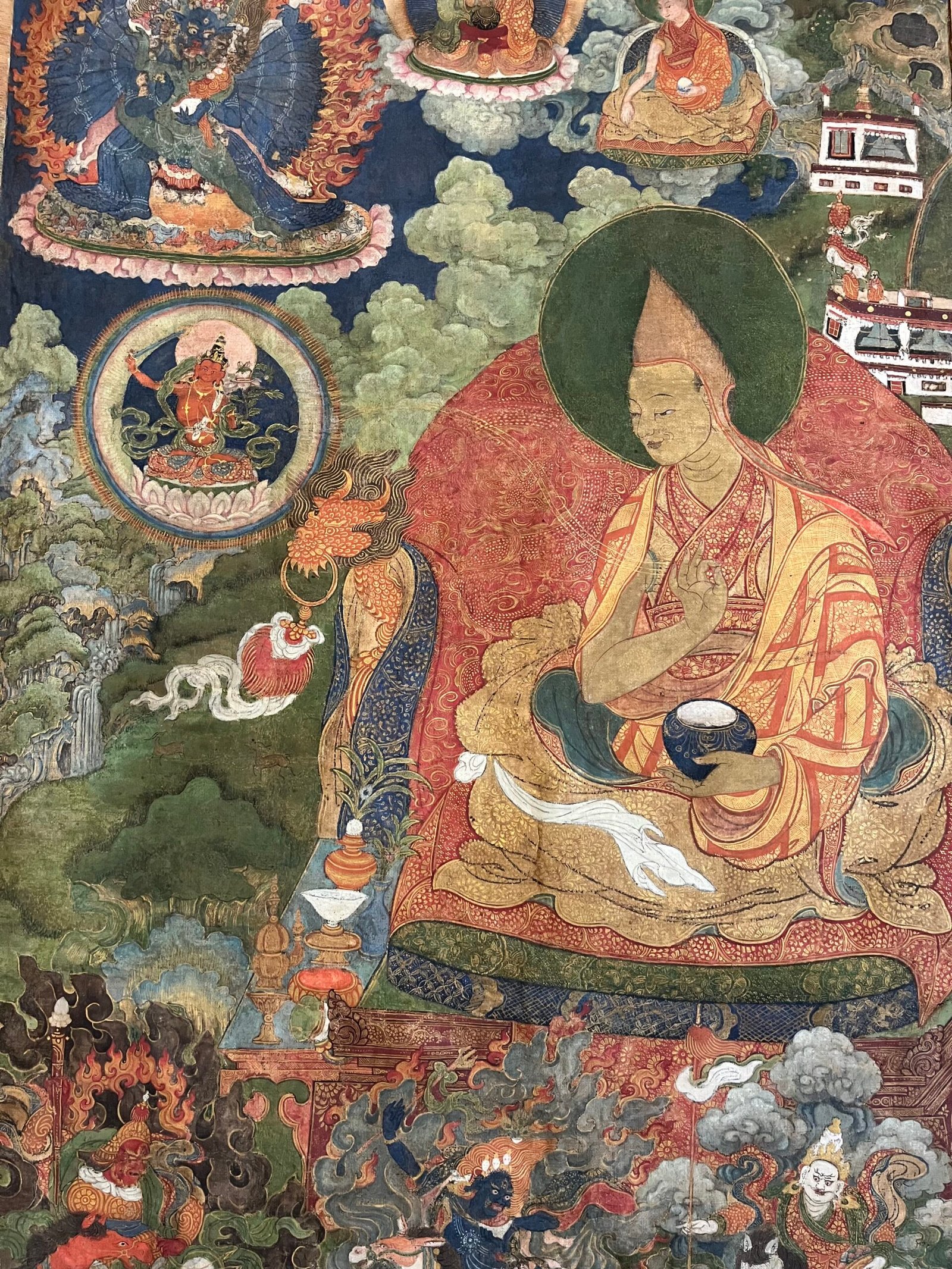
He is shown seated on a high throne, wearing monastic robes typical to the gelug clothing
style, and a pandita hat. In his left hand holding a blue alm bowl, his right hand is in the
teaching position of vitarka mudra. From the heart center of the Paṇchen Lama emanates a
rainbow sphere containing the bodhisattva Mañjuśrī (’jam dpal dbyangs), underscoring
Lobzang Yeshe’s identity as an emanation of transcendent wisdom and his close association
with the bodhisattva of wisdom and learning. Mañjuśrī can be seen on the left upon a lotus
throne, his body is reddis-orange in colour, encoles within a circular mandorla. His right hand
is raised, holding a flaming sword, the Sword of Wisdom (shes rab kyi ral gri), which
represents the power to cut through ignorance, delusion, and false views. His left hand is
positioned near his chest, likely holding the stem of a lotus, traditionally supporting a sacred
text (the Prajñāpāramitā Sutra), symbolizing ultimate knowledge, though the text itself may
be stylized or partially obscured in this composition.
Above, the composition is structured hierarchically. At the upper center appears Amitābha
Buddha (’od dpag med), the „Immeasurabel Light”. The name refers to his infinite awareness
wisdom (rig pa’i ye shes) that is without mental distortions, afflictive emotions, and habitual
tendencies, free from all stains and obscurations. Amitābha is the source of the Paṇchen
Lamas’ emanational lineage, red in colour, in the posture of meditation with both hands
folded in the lap, he holds a black begging bowl. This is Amitābha’s nirmanakaya form, the
form which appears in the nirmanakaya realm of Sukhavati or “Endowed with Bliss” (bde ba
can), the pure realm in the western direction. The upper left is the wrathful tantric deity
Vajrabhairava (rdo rje ’jigs byed), the furious emanation of Mañjuśrī, being a principal Gelug
protector. He is shown in yab yum union with his consort, Vajravetali (rdo rje ro langs ma).
The composition represents the highest tantric realization, where method or upāya (thabs) and
wisdom or prajñā (shes rab) are fully united. Vajrabhairava appears in a ferocious, blue
wrathful form, his face is fierce, with bulging eyes, bared fangs, and a wrathful expression,
conveying his role as the conqueror of death and ignorance. His hair stands upright, crowned
with skull ornaments, and he is encircled by a halo of blazing flames, representing the fire of
pristine awareness that consumes delusion. He stands in a dynamic, dancing posture upon a
lotus throne, signifying his transcendence over samsaric existence despite his terrifying
appearance. His multiple arms traditionally hold various tantric implements such as vajras,
skull cups, and ritual weapons, each symbolizing specific aspects of enlightened power and
the subjugation of inner and outer obstacles. Vajravetali, his wisdom consort (yum), is
depicted embracing him closely. Her body is greenish, and she holds ritual attributes and
wears bone ornaments, representing prajñā (transcendent wisdom). Above Vajrabhairava’s
head appears a small seated figure within a halo, identifying Mañjuśrī as the source deity,
reinforcing Vajrabhairava’s nature as Mañjuśrī ’s wrathful manifestation. At the upper right
is Khenchen Dorje Dzinpa (mkhan chen rdo rje ’dzin pa) an important lineage master
associated with the Paṇchen Lama’s transmission, wearing the traditional monk’s robes, with
an alm bowl in his left hand. His right hand is streched in bhumisparsha or earth touching
mudra.
The lower register is populated by powerful dharmapālas, the protectors of buddhism,
emphasizing the political and ritual authority of the Paṇchen Lama within the Gelug tradition.
At the bottom center Shri Devi Magzor Gyalmo (dmag zor rgyal mo) or Palden Lhamo (dpal
ldan lha mo), the main female protector of Tibet, rides her yellow mule, adorned with the
typical ornaments of the wrathful protectors of the Dharma: human skulls, halo of flames,
snakes, flayed human skin loops and her sack of sicknesses. Magzor Gyalmo is a wrathful
emanation of the peaceful goddess Sarasvati (dbyangs can ma). To her left appears the wordly
protector Dorje Setrab (rdo rje bse khrab), the „Vajra-armoured”, who, in one hand is
believed to be the emanation of Amitābha, in other hand an indigenous demon of Tibet,
subjugated by Padmasambhava. His body colour is red and seated atop a brown horse. He is
fearsome and holds in his right hand a red skull-stick. His left hand holds a lasso, and he is he
is completely surrounded by the brightly burning orange and red flames of wisdom fire. At
the right of Palden Lhamo stands the white wordly protector Chingkarwa (phying dkar ba),
the „White felt-capped”, who is another wordly protector of the Dharma. His appearance
reflects the typical appearance of a dralha (dgra lha), an indigenous wordly protector deity.
His body is white in colour with one face and two arms, riding atop a white horse, holding a
long spear in his right hand, and in the left a bowl of jewels held at the waist. The top of his
head is wrapped in a white cloth. Both wordly protectors are strongly associated with the
Tashilhunpo Monastery, the seat of the Panchen Lamas. Chingkarwa is commonly depicted as
a secondary figure in paintings of the Panchen Lamas.
The Tibetan script at the lowest part says:
མཁན་ཆེན་རྡོ་རྗེ་འཛིན་པའི་བཀའ་དྲིན་ལས།
།རྡོ་རྗེ་འཇིགས་བྱེད་དབང་དང་གདམས་པ་ཐོབ།
།འདོད་ཁམས་དབང་མོ་ཆོས་ཀྱི་བསྲུང་མར་བསྟེན།
།བློ་བཟང་ཡེ་ཤེས་གདུལ་བྱའི་བསོད་
ནམས་ཞིང་། །དེ་ལྟར་སྐྱེས་རབས་ཉི་མའི་གྲགས་ལྡན་པའི།
།སྣང་བརྙན་པར་དུ་སློབ་འཁོར་སྤྱི་ཚོགས་ཀྱིས།
།དད་པས་བསྒྲུབས་པའི་དགེ་ཚོགས་གངྒའི་རྒྱུན།
།ཀུན་ཀྱང་རྗེས་སུ་འཛིན་པའི་རྒྱན་གྱུར་ཅིག། །མངྒལཾ།
Through the benevolence of the great vajradhara master, I received the empowerments and
instructions of Vajrabhairava (rdo rje ’jigs byed). I rely upon Kāmadevī (’dod khams dbang
mo) as the guardian of the Dharma. In this way, may the Gaṅgā stream of accumulated merits,
gained through the devotion of the community of disciples for the sake of printing the image
of the renowned Lobsang Yeshe, the "Sun of the Successive of Lives," by the community of
disciples and attires, become an ornament that gathers all into his care. Mangalam!