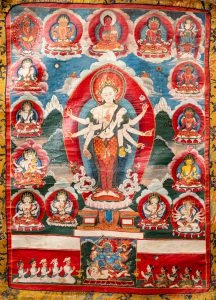
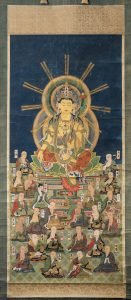
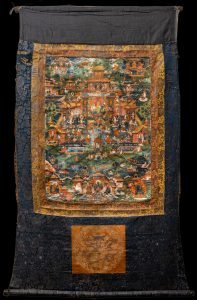
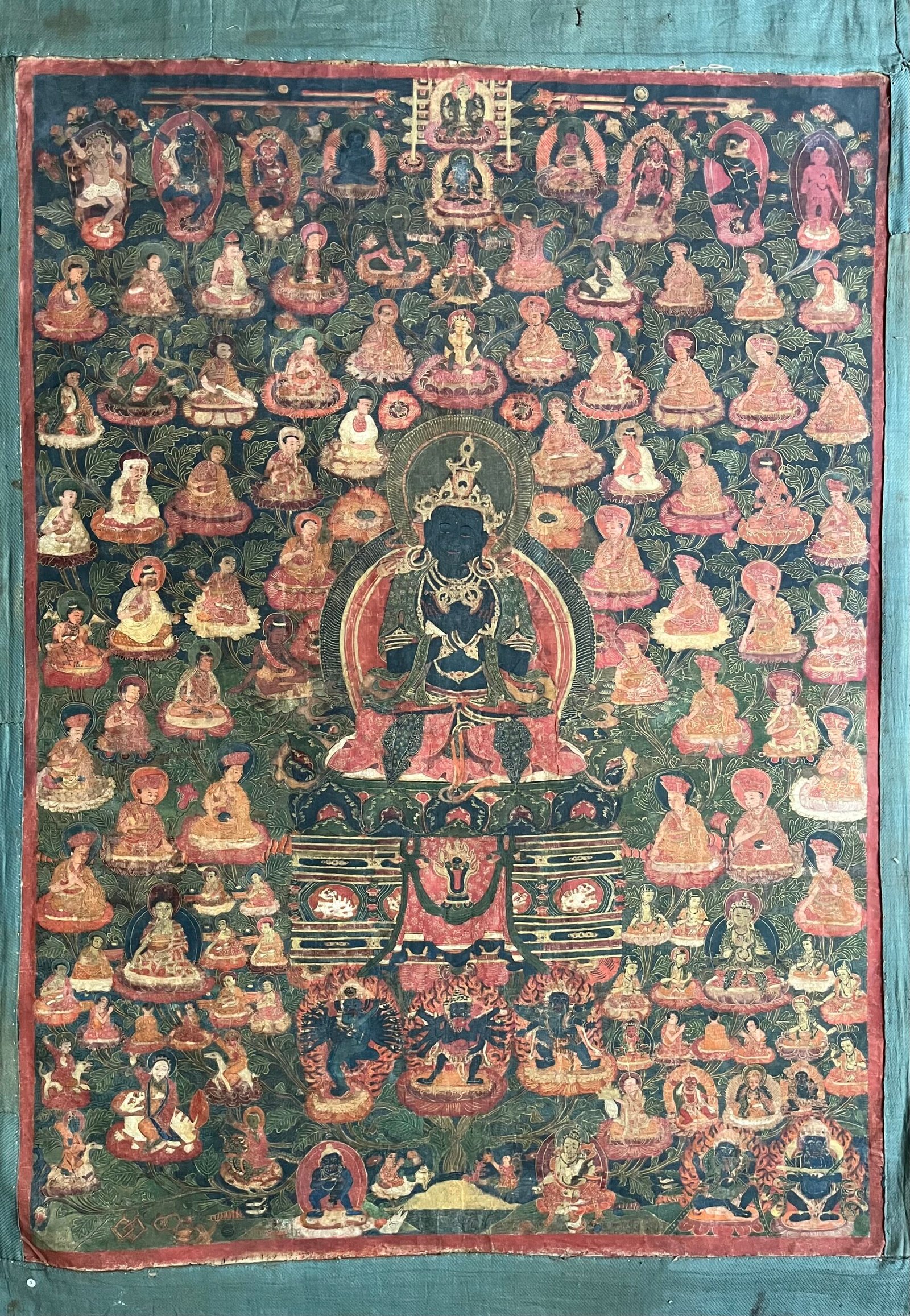
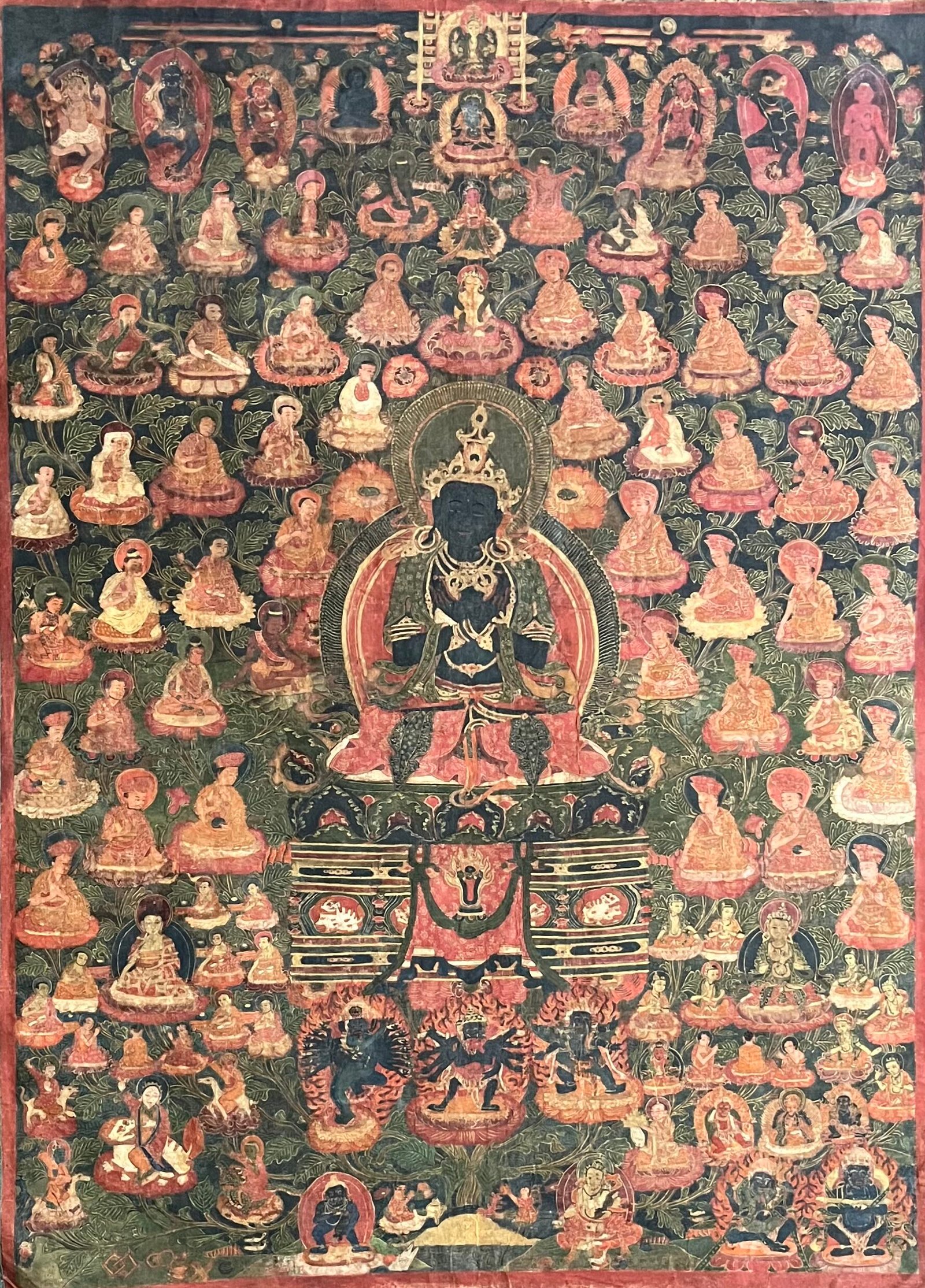
This large and richly populated thangka depicts a refuge tree or field of merit (khor yug shing)
of the Kagyü tradition (bka’ brgyud pa), a central visual support for refuge and bodhicitta
practices in Vajrayāna Buddhism. Such compositions present, within a unified image, the
complete spiritual genealogy of a Buddhist lineage – its primordial source, successive
teachers, meditational and protective deities, enlightened beings – serving both as an object of
devotion and an aid for visualizational meditation. It was intended to serve as a visual focus
for taking refuge in the Three Jewels (dkon mchog gsum), the Buddha (sangs rgyas), Dharma
(chos), and Sangha (dge ’dun), expanded in Vajrayāna practice to include the Three Roots
(rtsa ba gsum): the lama (bla ma), the yidam (yi dam), and the dakini (mkha’ ’gro ma) or
protector (srung ma). Such thangkas were used in monastic and advanced lay contexts during
refuge ceremonies, empowerments, and long-term meditation retreats, where visualizing the
refuge field was believed to confer blessings, accumulate merit, and strengthen the
practitioner’s connection to the lineage.
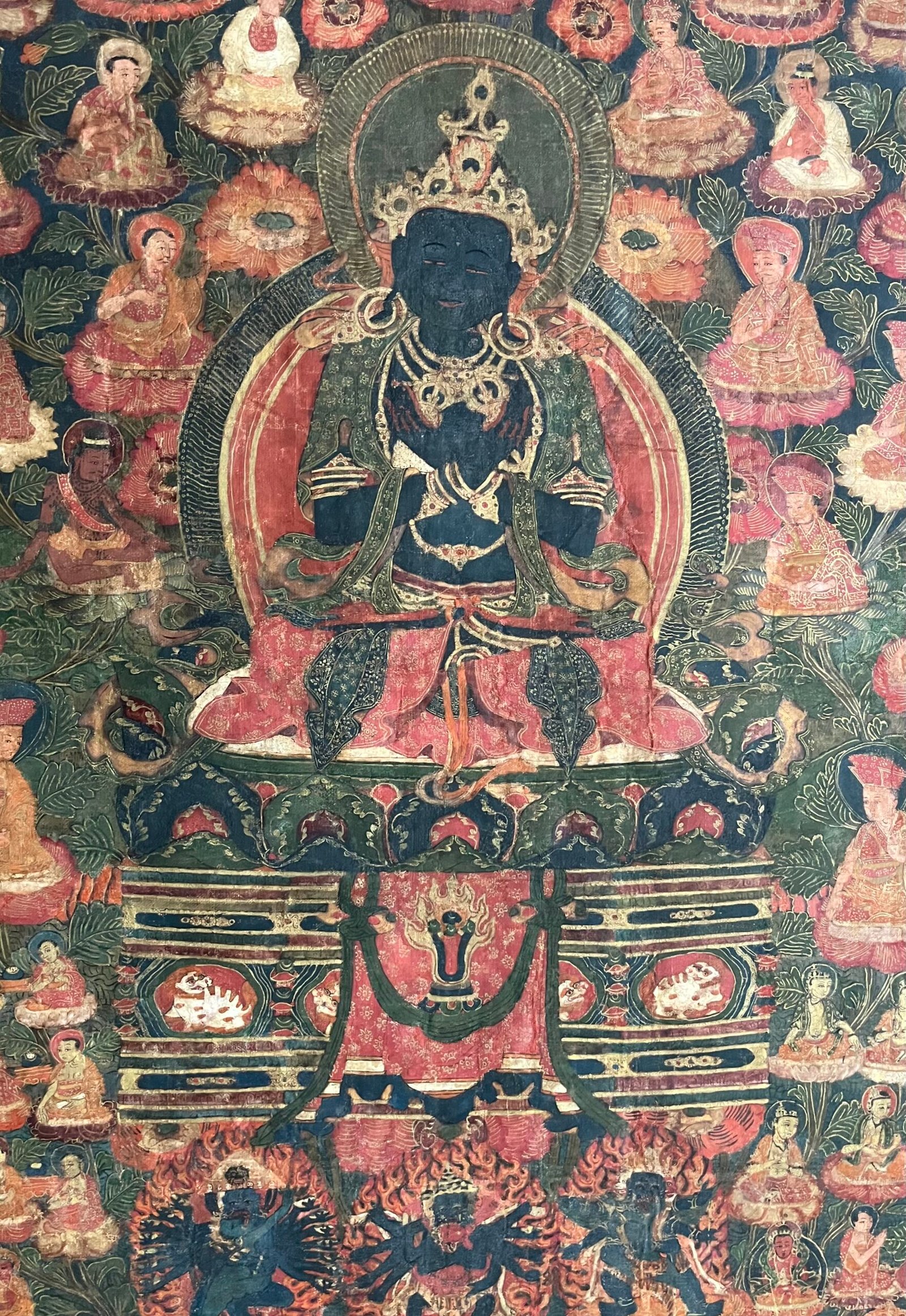
At the heart of the composition sits Vajradhāra (rdo rje chang) the primordial Adi-Buddha,
the personification of the dharmakāya, the „truth body”. In the Kagyü tradition, Vajradhāra is
revered as the universal root lama, the source of all tantric transmissions. He is depicted in
peaceful form, smiling face, dark blue in complexion, symbolizing the immutable and
boundless nature of awakened mind. Seated in vajra posture upon a lotus throne decorated by
lions, he holds the vajra (rdo rje) and bell (dril bu) crossed at his heart in the mudrā of non-
duality, signifying the inseparable union of method or upāya (thabs) and wisdom or prajñā
(shes rab). His figure is adorned with jeweled crown, ornaments, and silken garments, and
surrounded by an ornate halo and mandorla executed with generous use of gold.
In the upper region there are the Buddhas of the four directions: Amitābha (’od dpag med),
Amohasiddhi, (don yod grub pa), Ratnasambhava (rin chen ’byung ldan) and Akṣobhya (mi
’khrugs pa).
Encircling Vajradhāra is an extensive assembly of the kagyü lineage holders, the mahāsiddhas
(grub thob chen po) and masters such as Tilopa, Nāropa, and Maitrīpa give way to the great
Tibetan masters Marpa (mar pa), Milarepa (mi la ras pa) and Gampopa (sgam po pa),
followed by later Kagyü hierarchs including incarnations of the Karmapas and other lineage
holders. The lineage begins with Marpa (1012-1097), who show the teachings to Tibetans,
followed by his disciples, Milarepa (1028/40–1111/23) and Gampopa (1079-1153), who are
vital for preserving the Kagyü transmission. These figures are seated on lotus thrones in
meditation posture, holding texts, rosaries, or displaying characteristic hand gestures,
emphasizing oral transmission, meditative realization, and the unbroken continuity of the
lineage. Together, these figures embody the experiential and yogic roots of tantric realization.
In the lower region, yidams and protector deities are depicted in their tantric, wrathful forms.
According to the Kagyü traditions, Vajrabhairava (rdo rje ’jigs byed), Heruka (he ru ka) and
Mahākāla (nag po chen po) is most likely to be shown below the main figure of Vajradhara.
They all are blue in body colour, with multiple arms and wrathful appearance. Their hair
stands upright, crowned with skull ornaments, encircled by a halo of blazing flames,
representing the fire of pristine awareness that consumes delusion. All three stand in a
dynamic, dancing posture upon a lotus throne, signifying his transcendence over samsaric
existence despite his terrifying appearance. Their multiple arms traditionally hold various
tantric implements such as vajras, skull cups, and ritual weapons, each symbolizing specific
aspects of enlightened power and the subjugation of inner and outer obstacles.
The presence of yidams and dakinis in the tree underscores the protection within the practice.
The lower registers are populated by wrathful guardians, depicted with fierce expressions,
dynamic postures, and flaming aureoles, symbolizing their role in removing obstacles and
protecting the Dharma. Their placement at the base of the composition follows traditional
Tibetan iconographic hierarchy, anchoring and safeguarding the enlightened assembly above.
The background is densely filled with scrolling vegetal motifs rendered in green tones with
fine gold outlines, creating a continuous, all-encompassing sacred space. The figures are
arranged in symmetrical horizontal registers, leaving little empty space and reinforcing the
sense of a vast, interconnected field of enlightened presence.